What Used to Be a Farmer's Dream is Now a Reality
Can you really increase fertility and use less fertilizer?
For years this was written off as a joke. Cut your fertilizer and watch your fertility climb. Sure, right after the rain comes exactly when you need it. Then a few farmers did it, and the joke turned into a shrug: nice field, good year, must have caught the right rain.
We get it. One good strip proves nothing, and maybe we would have said the same thing.
So we quite arguing and kept on measuring. Four years later, here is what the numbers say, including the ones that did not go our way.
So is it possible?
The short answer is yes.
On more than 1,000 acres we have not applied phosphate since fall of 2021 or potash since fall of 2022, and the plant available numbers went up.
Not held steady. Went up.
Keep reading to learn more about why.
How do you know the nutrients are actually getting into the plant?
Because we stopped guessing at the soil and started reading the plant.
This is the part that changed everything, and five years ago nobody around here was measuring it.
DRIS (Diagnosis and Recommendation Integrated System). Instead of grading each nutrient against its own threshold, it looks at nutrients in ratio to one another, which is how they actually behave inside a plant. Negative means deficiency. Positive means excess. Zero is the target.
See the table below for the cumulative change from V10 to R2 in corn, in 2022 compared to 2026.
| Nutrient | 2022 | 2026 |
|---|---|---|
| Nitrogen | 0.18 | 0.60 |
| Phosphorus | -3.15 | 1.77 |
| Potash | -0.66 | -1.58 |
| Sulfur | -10.57 | 0.95 |
Sulfur climbed out of a 10.57 hole to essentially balanced. Phosphorus went from short to slightly long.
According to Nate, "I always had trouble getting nitrogen into the plant. Now I do it easily."
Read that again, because it's the entire point.
Nitrogen was the nutrient that he fought the hardest for. Not with more nitrogen but with soil biology that could actually deliver it to the plant.
What happens to soil test levels if you stop applying P and K?
They can climb, and the plant available numbers climb the most.
Below is a table of the same GPS points, sampled in 2022 and again in 2025 - measuring phosphorus in parts per million.
| Field and Zone | Soil Test P 2022 | Soil Test P 2025 | Plant Available P 2022 | Plant Available P 2025 |
|---|---|---|---|---|
| E House Zone 1 | 7.4 | 5.8 | 3.7 | 11.4 |
| J&J Zone 1 | 8.1 | 12.8 | 3.7 | 27 |
Read that first row again. The standard soil test went down. Plant available phosphorus tripled.
Those two columns measure different things. Your standard soil test counts inventory. The plant available number tells you what the crop can actually reach this season. If you read only the column your report leads with, you would have written a phosphate check on a field that was quietly getting richer.
Across all 16 zones, plant available potassium went up at every single one. Plant available phosphorus went up at 15 of 16.
John Lory at University of Missouri Extension
compares a soil test to a gas gauge, and then makes the point that matters: soil test recommendations do not always identify real need. The gauge says the tank is full. It says nothing about whether the fuel line is open.
Could it still just be one lucky field or one good year?
That was a fair question three years ago. But it's a harder argument to make now.
A fluke has to be one field, one year, or one place. So check it all three ways.
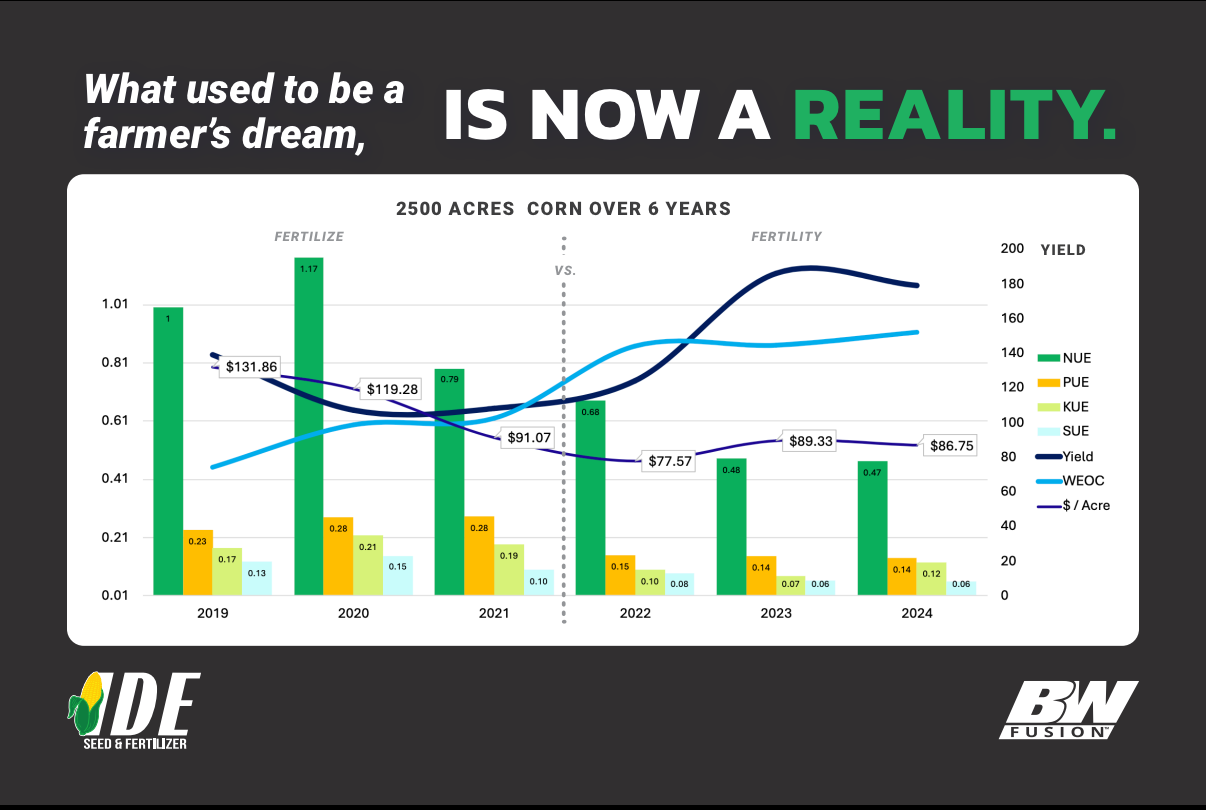
Sixteen zones across more than 700 acres, sampled at the same GPS points four years apart. Six years of records on 2,500 acres of corn, where fertilizer spend fell from $131.86 an acre in 2019 to $86.75 in 2024 while the yield line went up, not down, through a drought year and through a year with 30 inches of rain from April to July. And the same approach putting bushels on the board from North Dakota to Nebraska to Iowa.
We also proved it here, which matters more to you than any of it. More than 50 research projects in central Minnesota. More than 100 customers on 7,500 acres. Henderson, Winthrop, Gibbon, Stewart, Lamberton.
Any single one of those could be shrugged off. Together, they are harder to explain away.
What about fertilizer prices?
That is the real question, and now you have something to do about it besides hope.
It used to take 30 to 35 bushels of corn to pay for the fertilizer on an acre. Now it takes 50 at a minimum, and more on plenty of acres. That is 15 to 20 bushels that used to be yours, gone before you sell a load.
Do not wait on the market to fix it. Nitrogen did ease off this summer, but anhydrous is still running about 26% above a year ago, DAP is about 12% above last July, and USDA does not expect meaningful relief on energy or fertilizer until 2027.
Our own supplier says phosphates are historically high with no sign of coming down, because production costs are up and major producers have pulled back.
The factors that will decide fall pricing are the Strait of Hormuz, Middle Eastern supply, Chinese export policy and fourth quarter demand.
Not one of those is happening inside your fence line. What happens inside your fence line is whether the fertility you already paid for reaches the plant. That is the one lever you own, and the four years of data above is what it looks like when you pull it.
"When opportunity comes, it's too late to prepare." - John Wooden
So what is the first step?
A biological soil test on your ground, before you commit a dollar to fall fertility.
With a BaselineRx soil test, we look at what you have, what the plant can actually reach, and what it would take to move more of it into the plant.
If you tried a biological once and got nothing, we believe you. One jug on an undiagnosed acre is a coin flip. The test picks the program, not the other way around.
Fewer bushels owed to the fertilizer bill before you earn a dollar changes the shape of a whole year. That is really what this is about.
Less fertilizer and more fertility used to be a dream. Four years of numbers later, it is just how we (and many of your neighbors) are farming.

Stop Guessing and Start Getting Answers!
Reach out today to discuss a BaselineRx Soil Test for your fields.